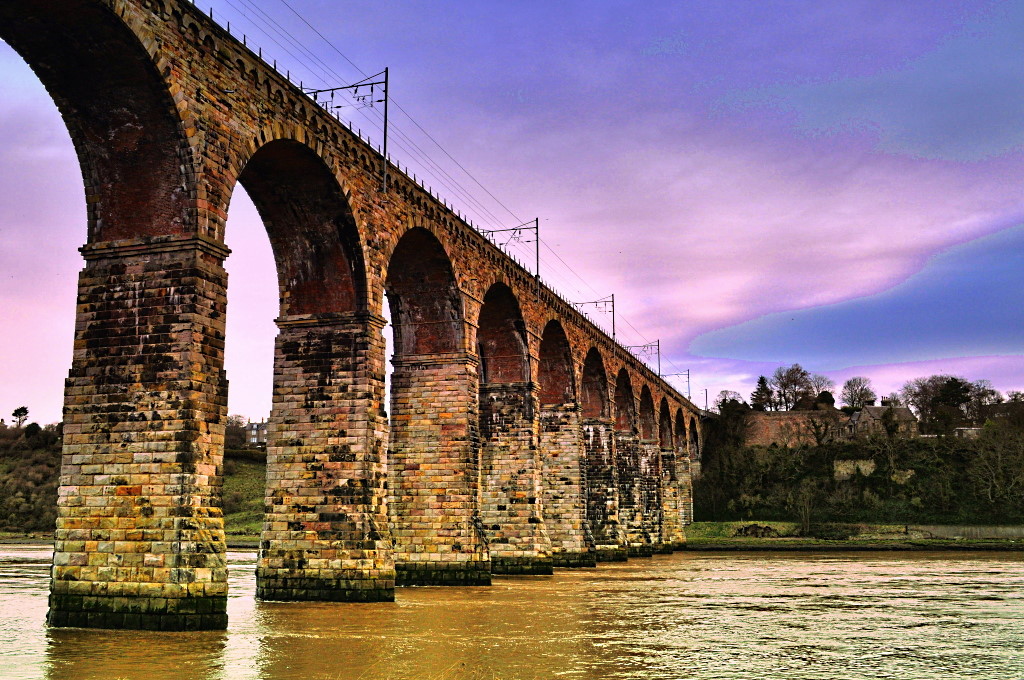
Berwick upon Tweed

Berwick upon Tweed has changed hands no fewer than fourteen times and although English since 1482, its football team still plays in the Scottish League !! The ramparts provide a popular promenade around the town and were built in their present form in the 16th century in response to the construction of a French fort at Eyemouth.

Berwick

Continue

St Abbs Village

Berwick upon Tweed (cont..)

The Barracks were designed by Nicholas Hawksmoor (more famous for his London churches) and built in 1711-21, making them the oldest in Britain. The Tweed is crossed by Old Berwick Bridge (1611) with its fifteen sandstone arches, the Royal Tweed Bridge (1925) and Robert Stephenson's Royal Border Bridge (1847-50), which carries the main East Coast railway line.

A frequent visitor was L. S. Lowry, famous for his matchstick men. He used to holiday here and as made over thirty sketches and drawings whilst visiting. Today there is the Lowry Trail which takes about 3 hours. Follows the Elizabethan Walls and crosses over to Tweedmouth and Spittal.

Berwick

BackContinue

St Abbs Harbour

Eyemouth

Eyemouth has been Scotland's largest south-eastern port since 1482 when Berwick upon Tweed was lost to England. In the wars of the mid-16th century Fort Point was fortified twice; by the English in the 1540s, and by the French several years later. Created a Burgh of Barony in 1597, Eyemouth is the largest town in Berwickshire and the river Eye's deep water is still ideal for landing boats.

Gunsgreen House overlooking the harbour was built by local smuggler and merchant John Nisbet in the 1750s. At this time, smuggling was called Free Trade and this coast was a centre for business. The house now tells its own story as a museum; continued through various walks and smugglers trails, around the local area, from St. Abbs in the north to Berwick-upon-Tweed to the south.

Eyemouth

BackContinue

St Abbs Head Lighthouse

Eyemouth (cont..)

The sights, sounds and smells of one of the busiest ports in Scotland show how important fishing still is to the town. Recent times see increasing use of the harbour for pleasure craft and diving interests. Eyemouth has many interesting buildings that chart a fascinating history including stories of smuggling, shipwrecks and witch-burning. One of the most poignant historical events is the disaster of October 1881, when a great storm wrecked many East Coast vessels and 129 Berwickshire men lost their lives. Eyemouth museum includes a display and tapestry depicting the events

The area's seafaring heritage is celebrated in its culture. Sea shanties and other traditional music can often be heard in harbour side hostelries. Work by local artists is on display to admire and buy. Each summer in July, the town's people crown a local lass the "Herring Queen" which is accompanied by a week of events.

Eyemouth

BackContinue

St Abbs Head Lighthouse

Burnmouth

Burnmouth is known for being the first and last village in Scotland when travelling the A1. Just south of Eyemouth and has an operational harbour.

The village is split over two levels, with homes and holiday cottages both top of the sea cliffs and beneath them.

Travel through the town and down The Brae to find the quaint harbour. It is the only landing for boats between Eyemouth and Berwick

Burnmouthk

Back

Coldingham Bay/Beach