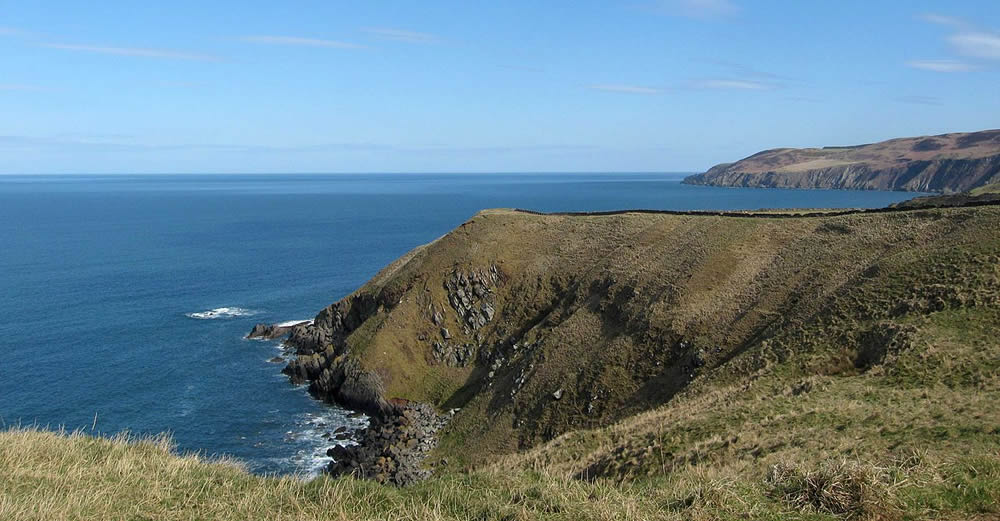
Cove Harbour

This place is magical, picturesque . It is also steeped in history.

Cove harbour is entered by a 180ft/55m tunnel, not seen from the village. It dates from the 1750's and once contained cellars which were used to store fresh salmon and herring, as well as cured and barrelled white fish.

Rich in the 18th century smuggling tales it is approached down a steep pathway from Cove village. At the bottom of the hill dynamite was used to create a dramatic tunnel in the soft sandstone rocks around 1700. There is more high drama in the natural rock formations and the famous hollow rock.

Alternatively, just enjoy pretty fishing boats and the sea views, sit on the quiet beach or explore some of the rock pools beyond the harbour wall.

Cove

Continue

Cove Harbour

Cove Harbour (cont..)

Cove village and harbour has a long fishing history and due to its hidden nature and tunnels, ideally suited to storing contraband, it has often been associated with smuggling.

In 1881, eleven men from Cove lost their lives in the great East Coast Fishing Disaster.There is a monument that remembers this tragedy at Cove Village. Find our more at the new St Abbs visitor centre.

Used as a landing place since at least the 17th century, the present harbour dates from 1831 and was built by the Hall family of Dunglass to facilitate the transport of coal mined inland.

Cove

BackContinue

Cove Harbour

St Helen's Kirk (Ruin)

Originally known as the church of Ald Camus this ancient ruin was reputedly built in the 12th century by the monks of Coldingham Priory who owned all of this land.

The former name was derived from Ald which means a small stream and Camus which is a bay. Some time after it was built it was dedicated to St Helen, hence the name change.

Located near the Old Cambus Quarry the original buildings probably comprised of both a church and a vicarage. The latter is known as written records note that the Vicar of Ald Camus swore allegiance to King Edward 1st in 1296.

While not much is left (as the kirk was already a ruin in the late 1700's) this is an evocative place to visit.

St Helens

BackContinue

St Helens Kirk

St Helen's Kirk Ruin (Cont...)

From Pease Bay follow the Berwickshire Coastal Path across the pedestrian bridge adjacent to the ford and proceed uphill to the first bend in the road. Follow the signposted path off the road, climbing steps up the sea braes and round the path on Pealands Bank.

This sea brae offers exceptional views of the Bay and East Lothian. At low tide the bay south of Pease has impressive rock strata formations.

In the distance you will see the ruins of the 12th Century St Helen's Church. Turn left on emerging to the tarmac road and follow it for a few hundred yards, until met with a sign post for St Helen's and Siccar Point.

St Helens

BackContinue

St Helens Kirk

Siccar Point

While you can read all about Siccar Point and James Hutton, nothing beats a real life visit.

Not only are the craggy rocks beautiful and dramatic but there is a great sense of occasion of 'walking in the footsteps of James Hutton and realising that these rocks played a fundamental role in discovering how 4.5 billion years ago our planet was formed.

There is a Hutton Trail Walk. A guided leaflet is available.

Siccar

BackContinue

siccarpoint1

Siccar Point (Cont...)

Follow the stone dyke from St Helen's Kirk along the cliff top. You pass through two fields, the dyke discontinues and a fence line leads you to an information board and kissing gate. you have reached Siccar Point; Hutton's unconformity is below.

You are not recommended to proceed down to investigate the geology of the rocks.

If you visited Siccar Poioint as part of walking the Berwickshire Coastal Path then either retrace your steps back to Pease Bay or continue on to Dowlaw carpark where you will see signposts for Fast Castle.

Siccar

BackContinue

siccarpoint1

Pease Dean

Pease Dean is an ancient semi-natural woodland, a remnant of the Wild Wood which once covered most of the United Kingdom after the last ice age ended about 10,000 years ago. Such woodland is now extremely scarce and largely restricted to steep valleys like Pease Dean.

A dramatic gorge and a more open valley managed by The Scottish Wildlife Trust. Like a small lost world, it is one of the very few places left in the area where old growth, native woodland can be found.

Shaded, sheltered and damp it also boasts a huge collection of mosses, liverwarts, woodland flowers and rare butterflies. Bird life includes woodpeckers, tree creepers, dippers and various tits and finches. You will also see Roe deer and red squirrels.

Pease Dean

BackContinue

priory

Pease Dean (cont..)

If you are on foot then from Cockburnspath follow the Southern Upland Way which passes under the A1 and East Coast railway line to the small settlement at Cove. Continue along the cliff tops to Pease Bay where the path runs into Pease Dean

If you are travelling by car head south on the A1 past Torness power station. At the roundabout, take the left exit to Pease Bay. There is a car park on the left. Cross the road and go through a kissing gate. Pease Dean is a short distance further on

Pease Dean

Back

prioryglass